Updated by 08.31.2026
What Is Payment Tokenization and How Does It Work?
It’s awkward and stressful to have to explain a data breach to your customers. The good news is, a stolen credit card number is only dangerous if someone can still use it. Payment tokenization makes that impossible. The real card number gets swapped for a random token during the transaction, so it never sits in a merchant’s systems in the first place. What does get stored carries no value to anyone outside the relationship that created it.
E-Complish builds tokenized processing into its payment solutions, so merchants can accept card and ACH payments, including recurring and one-time charges, without storing the data that makes them a target for fraud.
What Does Payment Tokenization Mean?
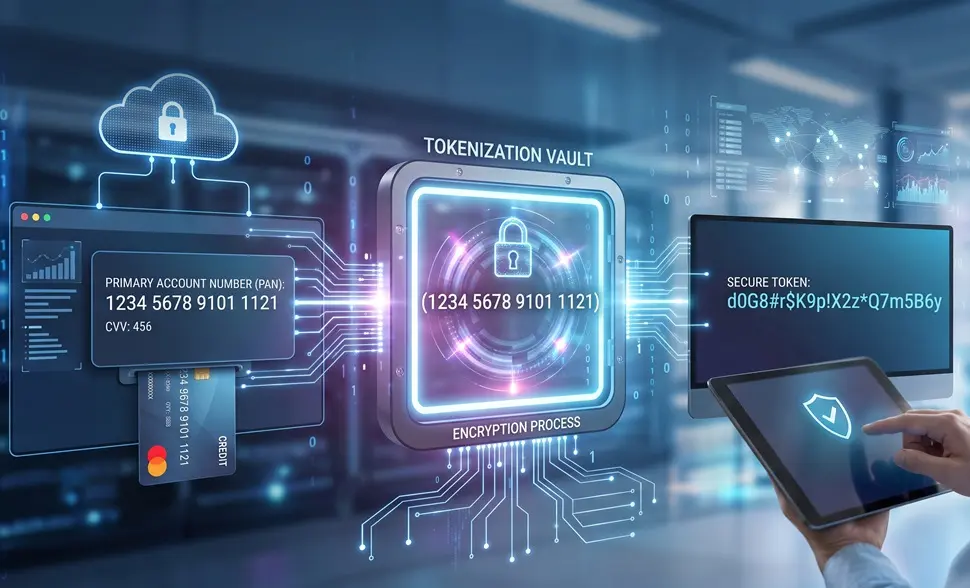
Payment tokenization replaces a customer’s card number, known as the primary account number (PAN), with a randomly generated string called a token. The token has no mathematical link back to the original number, so it carries no value on its own if intercepted.
The real card number is held separately, in a highly secured token vault operated by a payment processor, a card network, or a dedicated token service provider. You, as the merchant, will only ever handle the token, so even if your database is breached, there is no card data inside to steal.
In short:
- What gets replaced: The real card number (PAN).
- What gets created: A token with no reversible link back to that number.
- Who holds the real data: A secured vault, not the merchant.
That basic swap, a real number replaced by a meaningless one, is the foundation every method below builds on.
How Payment Tokenization Works (6 Steps)
Tokenization runs in the background of a transaction and finishes in a fraction of a second. The process generally follows six steps:
- Card entry: The customer enters card details at checkout, in an app, over the phone, or by tapping a device at a terminal.
- Secure transmission: That data travels to a token service provider, typically the payment processor or a specialized vault operator.
- Token generation: The provider swaps the real card number for a unique token and moves the actual PAN into a secured vault.
- Token storage: The merchant’s system keeps only the token going forward and never touches the original card number again.
- Transaction routing: When a charge runs, the token travels through the payment network and gets matched back to the real card data inside the vault to complete authorization.
- Reuse: For repeat purchases, subscriptions, or saved payment methods, the same token gets reused, so the customer never has to re-enter a card number.
Because the vault, not the merchant, holds the sensitive information, a business can run recurring and repeat transactions at any scale while storing zero card numbers, and the exchange adds no noticeable delay at checkout or on a call. The provider running that vault, usually a payment processor, a card network, or a dedicated vault operator, is often called a token service provider (TSP).
Payment Tokenization vs. Encryption: The Key Difference
Tokenization and encryption both protect card data, but they solve the problem in different ways. Encryption scrambles data using a mathematical formula and a key, so anyone holding that key can convert the data back to its original form. Tokenization removes the original data entirely and replaces it with a value that has no formula to reverse, which means there is no key for an attacker to steal or crack.
The practical difference shows up in a few places:
- Reversibility: Encrypted data can be decrypted by design; a token cannot be converted back into a card number without access to the vault that created it.
- Breach impact: A stolen token has no resale value, since it only has meaning within the specific merchant, device, or transaction context that created it; a stolen encryption key can unlock every record it was used to protect.
- PCI DSS scope: Tokens carry lighter compliance requirements than raw card numbers under PCI DSS: the Payment Card Industry Data Security Standard, covered in more detail below.
Many payment providers use both. Data may be encrypted in transit between systems, then tokenized the moment it reaches a merchant’s own environment.
Think of it like a coat-check ticket. The ticket lets you claim your coat without your name ever being printed on it, and losing the ticket doesn’t hand a stranger your coat, only the counter can make that match. A token works the same way: it stands in for the transaction, but only the vault can trace it back to a real card.
Look Inside Your Own Token Vault
Not every processor tokenizes card and ACH data the same way. Tell us what your current setup handles, and we'll show you how a token vault would fit into it.

The Two Main Types of Payment Tokens
Not every token behaves the same way. The type in use affects how smoothly things run when a card gets replaced or a business switches providers.
Network Tokens
Network tokens are issued directly by a card network, such as Visa or Mastercard, rather than by an individual processor. When a customer’s card is lost, stolen, or reissued with a new expiration date, the network updates the token behind the scenes. Subscriptions and saved payment methods keep working without you having to contact the customer for new card details.
Gateway and Merchant Tokens
Gateway tokens, sometimes called PCI tokens, are generated and stored by a specific payment processor or gateway rather than a card network. They protect card data just as effectively day-to-day. Because the token only has meaning inside that one provider’s vault, switching to a different processor later can require the customer to re-enter payment details.
Benefits of Payment Tokenization for Merchants
Tokenization changes more than the back-end architecture of a payment system. It changes what a business is exposed to if a breach or fraud attempt happens. The most common benefits include:
- Smaller data footprint: Card numbers never sit inside the merchant’s own database, so there is far less sensitive data to lose in an attack.
- Reduced PCI DSS scope: A token-only system skips the full cardholder-data-environment review that raw-card systems have to complete.
- Lower fraud exposure: A breach exposes nothing a criminal can actually use.
- Smoother recurring billing: Subscription and membership businesses can charge a stored token on schedule without re-collecting a card number each cycle.
- Support for digital wallets: Apple Pay, Google Pay, and similar wallets rely on device-level tokens to keep a stored card usable without exposing the number to every merchant it’s used with.
- Easier vendor changes: A business that switches point-of-sale or e-commerce providers can often carry a network token forward instead of asking every customer to re-enter their card.
Taken together, these benefits are why tokenization now sits alongside encryption as a baseline expectation for handling stored card data.
Where Tokenization Shows Up in Everyday Payments

Tokenization operates quietly across nearly every channel a customer might use to pay.
- Card-on-file and subscriptions: Utilities, healthcare billing, and membership businesses store a token instead of a card number for repeat and recurring charges.
- E-commerce checkout: Returning customers get a one-click purchase experience because the site holds a token, not the underlying card number.
- Mobile and contactless wallets: A phone tapped at a terminal sends a device-specific token, not the card number stored underneath it.
- API-based integrations: Businesses running their own app or website can process tokenized transactions directly through a payment API instead of handling raw card data at all. The DevConnect API supports this case, letting a business route card data through a secured system instead of handling it directly on their own servers.
- Call center and phone payments: A representative can take a payment or set up a stored token without writing down or storing the customer’s full card number anywhere. CallSentry supports this by muting sensitive card details from the representative while the customer stays on the call, so the representative and the business only ever handle the token.
- ACH and bank transfers: The same swap-and-vault approach applies to bank account and routing numbers, not just card numbers, so ACH payments can be tokenized the same way as card transactions.
The channel changes from one bullet to the next, but the outcome doesn’t. The token is what moves through the transaction every time, and the real card number stays out of reach throughout.
Payment Tokenization and PCI DSS Compliance
PCI DSS (the Payment Card Industry Data Security Standard) is the security standard the card networks require of any business that stores, processes, or transmits card data. It’s maintained by the PCI Security Standards Council, an industry body, not a government agency. Here’s how tokenization actually relates to it:
- Doesn’t grant compliance on its own: Tokenization doesn’t automatically make a business PCI compliant.
- Shrinks what’s in scope: Removing raw card numbers from a merchant’s own systems is one of the most effective ways to reduce what falls inside a PCI DSS audit.
- Vault still in scope: The vault or cardholder data environment that stores the real card number remains inside PCI DSS scope, even though the merchant’s own systems fall out of it. That’s why businesses typically choose a processor whose vault has already passed its own PCI assessment, rather than carrying that scope in-house.
- NIST guidance: NIST’s 2021 guide on securing hotel property-management systems recommends tokenization of credit card data as one of the controls that align with PCI DSS.
- FTC Safeguards Rule: Under the FTC’s Safeguards Rule covered financial institutions must protect customer information through encryption or an equivalent safeguard, in transit and at rest; a standard tokenization helps satisfy this.
None of this replaces a formal PCI DSS assessment, but it explains why standards bodies and regulators keep pointing to tokenization as a core safeguard.
E-Complish and Tokenized Payment Processing
The safest data is data that’s worthless if it’s ever exposed. To protect your customers and your reputation, consider payment tokenization. It turns the data criminals want most into a string of characters they can’t use anywhere else. For a payment processor built around utilities, healthcare organizations, government agencies, financial institutions, credit unions, and collection agencies, that protection has to hold up across every channel a customer might pay through, from a text link to a recurring subscription.
E-Complish builds tokenization into its payment processing, so your business can accept payments without holding onto the data that puts it at risk. Contact us to talk about a tokenized payment setup built for your business.
Table of Contents
Table of Contents