Updated by 07.23.2026
How to Dispute a Chargeback Successfully
It’s your right as a merchant to dispute a chargeback. Done correctly, it’s also winnable. This guide walks through how the dispute process actually works, what evidence moves the needle, and where merchants most often go wrong.
If you’re looking for ongoing protection rather than reactive disputing, E-Complish’s chargeback management service automates evidence collection and dispute response across your entire transaction volume.
What a Chargeback Actually Is (And Why It Costs More Than the Sale)
A chargeback is a forced payment reversal initiated by a cardholder’s bank, not by the cardholder contacting you directly. The issuing bank credits the customer provisionally, debits your account, and charges you a fee that ranges from $20–$100 per dispute, regardless of outcome.
By the time you’re notified, the money is already gone.
What makes chargebacks especially costly is the total damage they cause. When processing fees, lost product, and administrative time are taken into account, the total cost of a single chargeback can reach 2.5 times the original transaction value. And whether you win or lose, the dispute still counts against your chargeback ratio — a metric card networks like Visa and Mastercard use to decide whether your merchant account stays open.
That’s why disputing invalid chargebacks matters. Winning doesn’t just recover revenue showcases that you’re not an easy target.
The Chargeback Dispute Process, Step by Step
Understanding the sequence matters. Miss a deadline at any stage, and you lose the right to respond, regardless of the strength of your case.
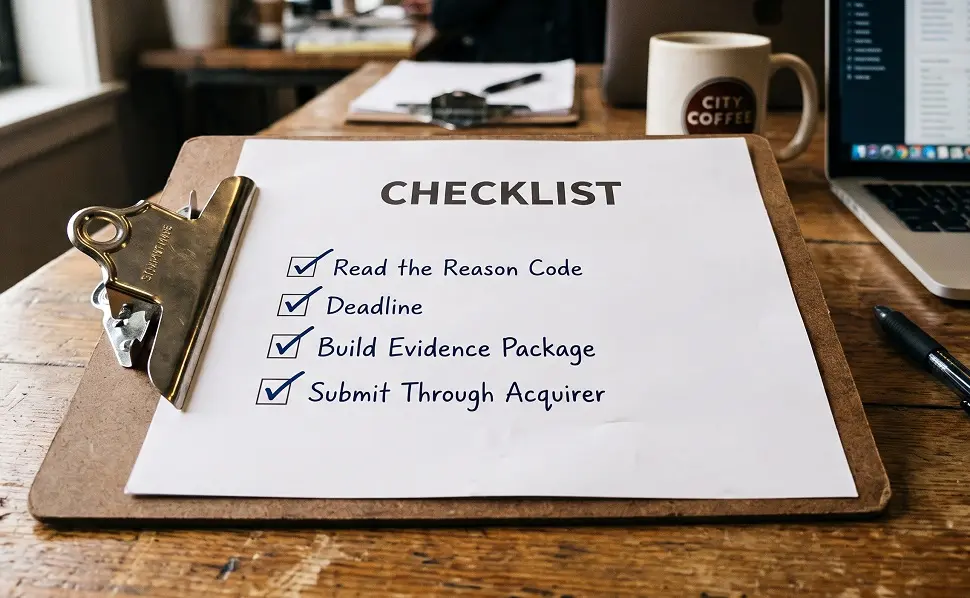
Step 1: Read the Reason Code
Every chargeback arrives with a reason code assigned by the card network. This code tells you exactly why the dispute was filed, and it controls everything that follows: the deadline you’re working against, the type of evidence required, and whether a dispute is even worth pursuing.
Common reason code categories include:
- Fraud (e.g., Visa 10.4, Mastercard 4853): Cardholder claims they didn’t authorize the transaction.
- Item not received (e.g., Visa 13.1): Customer says the order never arrived.
- Item not as described (e.g., Visa 13.3): Customer claims what they received didn’t match the listing.
- Duplicate processing/credit not processed: Billing or refund errors on the merchant’s end.
If the reason code points to a merchant error, such as a wrong amount charged or a refund not issued, accept the chargeback. Fighting an accurate claim wastes time and fees you won’t recover.
Step 2: Know Your Deadline
Dispute windows are short. Most card networks give merchants 7–30 days to respond from the date of notification, depending on the network and the acquiring bank’s internal processing time.
Visa and Mastercard have different timelines, and your payment processor may have its own layer on top. When in doubt, assume the deadline is sooner than it appears. Some payment processors don’t notify merchants until several days after the response window has already begun.
Missing the window means automatic acceptance, plus a non-response fee in some cases.

Step 3: Build Your Evidence Package
This is where most merchants underinvest. A strong chargeback dispute isn’t just a note saying “we fulfilled the order”. It’s a documented case that maps directly to the reason code.
For fraud-related chargebacks:
- Transaction data with date, time, and IP address
- AVS (Address Verification System) and CVV match confirmation
- Device fingerprint or 3D Secure authentication record
- Cardholder’s purchase history with your business
For non-delivery claims:
- Carrier tracking showing delivery confirmation
- Signed delivery receipt (where applicable)
- Customer email confirming receipt, or prior communications
For “not as described” disputes:
- Your product or service description at the time of purchase
- Photos or screenshots of what was delivered
- Any customer service communication after the issue was raised
Always include a rebuttal letter. This is a summary, typically one page, that explains your position, maps each piece of evidence to the reason code, and makes it easy for the issuing bank’s reviewer to rule in your favor. It’s the organizing document of your dispute package.
Step 4: Submit Through Your Acquirer
You don’t send evidence directly to the cardholder’s bank. You submit to your acquiring bank or payment processor, who forwards it to the issuer. This is called representment, as you’re re-presenting the charge and asserting it was valid.
Keep copies of everything you submit. If the case escalates, you’ll need to know what evidence has already been reviewed.
Chargebacks Don't Have to Drain Your Revenue
E-Complish gives businesses the payment processing infrastructure and reporting tools to identify dispute patterns early. Reach out today, and let's talk about what's costing you.

What Happens After You Dispute
Once the issuing bank receives your package, they have 30–45 days (depending on the network) to make a decision. There are three possible outcomes:
- Dispute resolved in your favor — the chargeback is reversed; funds return to your account. The chargeback fee is not refunded, and it still counts against your ratio.
- Dispute upheld — the cardholder wins. You’ve lost the sale, the fees, and the product.
- Second chargeback (pre-arbitration) — the issuer re-opens the case with new information from the cardholder or because a reason code has changed. Mastercard, Discover, and American Express allow a second round; Visa limits pre-arbitration to one cycle.
If a second chargeback is filed, don’t simply resend the same documentation. Take time to understand what has changed and provide evidence that specifically addresses the new claim.
Arbitration: The Last Resort
If you and the issuer still disagree after pre-arbitration, you can request arbitration from the card network itself. Arbitration fees run $500–$900 or more per case, and the card network’s decision is final. It’s rarely the right move for transactions below $1,000.
When to Fight and When to Accept
Not every chargeback deserves a dispute. In some cases, accepting some chargebacks is the correct business decision.
Fight the chargeback when:
- You have clear evidence that the transaction was authorized and fulfilled.
- The chargeback reason code doesn’t match what actually happened.
- The transaction value justifies the time and fees.
Accept the chargeback when:
- The customer’s complaint is valid, and you can’t disprove it.
- The transaction amount is too small to justify the dispute cost.
- The evidence you’d need simply doesn’t exist.
Disputing chargebacks you can’t win wastes internal resources and doesn’t improve your ratio.
How to Reduce Chargebacks Before They Start

Prevention is the most effective chargeback strategy. Disputes are easier to avoid than to win.
A few practices that reduce chargeback frequency:
- Use clear billing descriptors. If customers can’t recognize the charge on their statement, they’ll dispute it. Make sure your business name appears exactly as customers know it.
- Respond to customer complaints fast. Many chargebacks occur because a customer tried to contact you and didn’t get an answer. A refund you issue voluntarily is less expensive than a chargeback you lose. See when a merchant should not issue a refund for cases where accepting the chargeback is still the wrong call.
- Enable 3D Secure authentication for card-not-present transactions. It shifts fraud liability to the issuing bank in most cases. For more on card-not-present transaction risks, see our dedicated guide.
- Keep detailed transaction records. If you can’t pull delivery confirmation, authorization data, and customer communications within 24 hours, your dispute process is already at a disadvantage.
- Monitor your chargeback ratio. Visa’s threshold is 0.9% (standard) and 1.8% (high risk). Mastercard’s is 1%. Once you exceed these thresholds, you enter monitoring programs that can lead to higher fees and eventual account termination. Our guide on how to stop chargebacks before they occur covers prevention tactics in more detail, and addressing friendly and malicious chargeback fraud breaks down how to tell the two apart.
How E-Complish Supports Your Payment Operations
Winning a chargeback often comes down to having the right transaction data. If your payment systems don’t capture and store that information properly, defending against the dispute becomes much more difficult. E-Complish provides PCI- and HIPAA-compliant payment processing for utilities, healthcare providers, credit unions, government agencies, and financial institutions nationwide.
Our platform supports ACH, card, IVR, and recurring payment workflows with full transaction reporting, giving your team the documentation needed to respond to disputes quickly and accurately. Contact us to learn more about our payment solutions and how we can support your business.
Table of Contents
Table of Contents